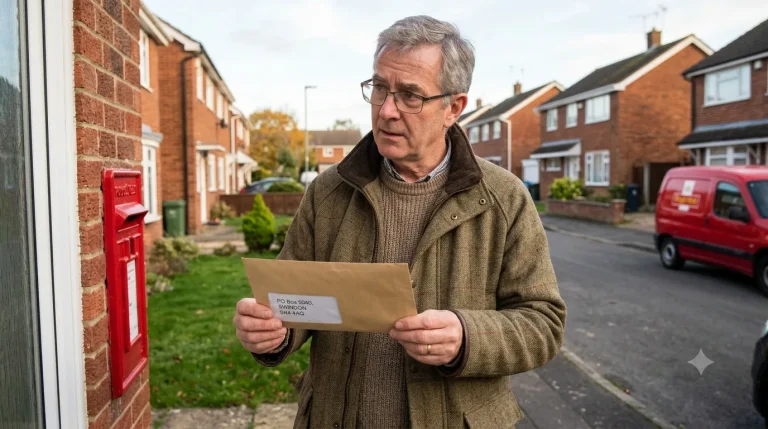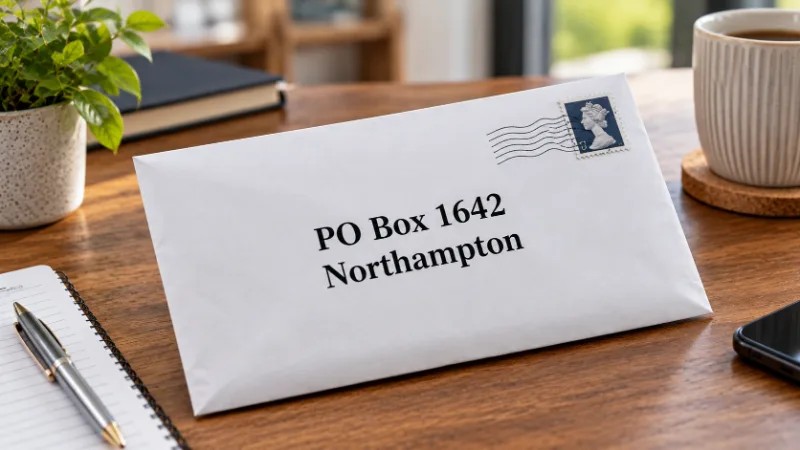

PO Box 1642 Northampton NN1 9LP is a return or mailing address that has appeared on correspondence connected with matters such as private parking charges and debt-related communications.
However, the PO Box address alone does not prove that a letter was sent by Northampton County Court or HM Courts and Tribunals Service.
This distinction is important because the current official address for the Civil National Business Centre (CNBC) is St Katharine’s House, 21–27 St Katharine’s Street, Northampton, NN1 2LH. HMCTS does not currently list PO Box 1642 as the CNBC’s main correspondence address.
If you receive a letter showing PO Box 1642 Northampton, check the organisation named inside the correspondence, the reference or claim number, what the letter is asking you to do, and any deadline before making a payment or responding.
Last Updated: 09.09.2026
Who Sends Letters From PO Box 1642 Northampton?
There is no single publicly confirmed organisation that can safely be assumed to be behind every letter carrying PO Box 1642 Northampton NN1 9LP.
Reports from recipients show the address appearing as a return address on private parking-related correspondence.
For example, consumers have reported receiving private parking notices where PO Box 1642 appeared on the envelope even though the parking operator itself was based elsewhere.
This means the organisation named within the letter is more important than the PO Box printed on the envelope.
Can You Identify the Sender From the PO Box Alone?
Not reliably.
A central mailing address can be used to process large volumes of correspondence. The return address therefore does not necessarily identify the business that issued the original charge, debt demand or legal notice.
When checking a letter, look for:
- Sender Name: Identify the company, creditor, parking operator or court named in the document
- Reference Number: Check for a parking reference, account number or court claim number
- Reason for Contact: Establish exactly what payment, debt or incident the letter concerns
- Contact Details: Verify them independently rather than relying solely on the letter
- Response Deadline: Take particular care where court proceedings or pre-action correspondence are involved
Do not assume that a Northampton address automatically means court proceedings have started.
Why Is This Address Used for Parking and Debt Letters?
Businesses that send large volumes of notices may use centralised mailing and return-address services. This can explain why a company based elsewhere appears to send correspondence through a Northampton PO Box.
For the recipient, the practical question is not simply where the envelope came from. It is who is making the claim and what stage the matter has reached.
A parking notice, debt collection demand, Letter Before Claim and County Court Claim Form can all require very different responses.
Is PO Box 1642 Northampton an Official Court Address?
PO Box 1642 Northampton NN1 9LP should not automatically be treated as the current official postal address of the Civil National Business Centre.
The Civil National Business Centre is part of the County Court system and handles money claims for England and Wales.
Its current official address is:
Civil National Business Centre
St Katharine’s House
21–27 St Katharine’s Street
Northampton
NN1 2LH
HMCTS currently publishes this address for paper money claims and responses to claims handled through the CNBC.
Therefore, seeing PO Box 1642 on an envelope does not by itself confirm that the court sent it.
County Court Business Centre vs Civil National Business Centre
Older articles and correspondence may refer to the County Court Business Centre, usually shortened to CCBC.
Current court rules and HMCTS services now use the name Civil National Business Centre, or CNBC. The CNBC forms part of the County Court administrative system and deals with large volumes of civil money claim work.
This change matters because older information online may still refer to the CCBC when discussing Northampton money claims.
If you are checking whether current correspondence is genuine, use current HMCTS details rather than assuming that information from an older web page is still correct.
What Type of Letter Could You Receive From PO Box 1642?
The type of document matters more than the return address.
Private Parking Charge Notices
A private parking operator may issue a Parking Charge Notice following an alleged breach of parking terms on privately managed land.
Examples might involve:
- Staying longer than the permitted period
- Parking without making the required payment
- Failing to enter a registration correctly
- Parking outside the operator’s stated conditions
A private parking charge should not automatically be confused with a council-issued Penalty Charge Notice.
Government guidance distinguishes private parking tickets from council parking penalties and tells motorists to check who issued the ticket before deciding how to challenge or pay it.
Debt Collection Letters
A parking charge or other unpaid balance may eventually be passed to a debt collection company.
Receiving a debt collection letter does not necessarily mean that a court judgment already exists.
Check:
- Who the original creditor is
- What the alleged debt relates to
- How the amount has been calculated
- Whether previous notices were issued
- Whether legal proceedings have actually started
If you dispute the debt, do not assume that paying immediately is your only option.
Letters Before Claim
A Letter Before Claim or Letter of Claim generally indicates that legal proceedings are being considered but have not necessarily been issued yet.
Pre-action rules expect parties to exchange enough information to understand the dispute and, where possible, try to resolve it before proceedings begin.
Do not confuse a Letter Before Claim with an actual County Court Claim Form.
County Court Claim Forms
An actual claim form represents a more serious stage.
A money claim should identify information such as:
- The Claimant
- The Defendant
- The Claim Number
- The Amount Claimed
- Court Fees
- Particulars of Claim
- Instructions for Responding
The response procedure depends on how the claim was issued, so follow the instructions contained in the claim rather than relying only on the envelope’s return address.

How Can You Tell If the Letter Is Genuine?
An official-looking envelope does not prove that a demand or claim is genuine.
HMCTS itself warns that scammers can imitate genuine court telephone numbers and email addresses. Anyone unsure about a demand should verify the details independently before paying.
Check the Sender and Reference Number
Start with the document rather than the envelope.
Look for:
- The Full Name of the Organisation
- The Claimant or Creditor
- A Claim or Account Reference
- Your Correct Name and Address
- Details of the Alleged Debt or Parking Event
- Dates and Amounts Claimed
For a court claim, make sure the document clearly identifies the court process and contains instructions explaining how to respond.
Verify Contact Details Independently
Do not automatically telephone a number simply because it appears on a threatening letter.
If the correspondence claims to come from HMCTS, compare the information against official court contact details.
The current published CNBC telephone number for general money claim enquiries is 0300 123 1056.
For private parking or debt correspondence, find the organisation’s official contact information independently.
Check Any Deadlines or Response Instructions
Deadlines are particularly important when the document is a genuine court claim.
Do not assume that every letter showing PO Box 1642 carries the same deadline. A parking notice, Letter Before Claim and County Court claim all have different procedures.
What Should You Do If You Receive a County Court Claim Form?
Do not ignore a genuine claim form.
The appropriate response depends on whether you accept or dispute the amount being claimed.
Pay or Admit the Claim
If you accept that the full amount is owed, you may be able to pay the claimant or formally admit the claim.
If you cannot pay everything immediately, the court paperwork may provide a procedure for supplying financial information and proposing instalments.
Keep evidence of any payment made.
Defend the Claim
If you disagree with all or part of the claim, you can file a defence.
A defence should address why the claim is disputed rather than simply stating that you do not want to pay.
Depending on the dispute, useful evidence might include:
- Payment Records
- Parking Receipts
- Photographs
- Emails or Letters
- Previous Appeals
- Contracts or Account Statements
- Evidence Showing You Were Not Responsible
Keep copies of anything you submit.
Acknowledge Service
An acknowledgment of service can be used in relevant Part 7 claims when you intend to defend but require additional time to prepare the defence.
Under the Civil Procedure Rules, the general deadline for filing an acknowledgment of service is 14 days after service of the claim form or particulars of claim, depending on how they were served.
Filing an acknowledgment of service does not mean admitting the claim.
How Long Do You Have to Respond to a Court Claim?
For many standard civil claims, the deadline is calculated from the date the claim or particulars of claim are legally treated as served.
This is different from simply counting from the date on which you happened to open the envelope.
Always check the claim form itself.
The 14-Day Response Period
Under the Civil Procedure Rules, the general rule is that an acknowledgment of service must be filed within 14 days after service.
A defendant who wants to defend a claim will also generally have 14 days after service of the particulars of claim to file a defence unless an acknowledgment of service has been filed.
When May You Have Up to 28 Days?
Where a valid acknowledgment of service has been filed, the general defence deadline becomes 28 days after service of the particulars of claim.
However, some online civil money claims operate under different procedural arrangements.
The safest approach is therefore to follow the specific deadline shown on the claim or in the relevant online money claims account.
Do not assume that every Northampton claim automatically gives you 28 days.
What Happens If You Ignore a Genuine Court Claim?
Ignoring an ordinary demand letter and ignoring an issued County Court claim are not the same thing.
Where a defendant fails to respond to a genuine court claim within the required period, the claimant may be able to request judgment in default.
The Civil Procedure Rules specifically allow default judgment in qualifying cases where the defendant has not filed the required acknowledgment, defence or admission.
Default Judgment
A default judgment means the court can give judgment without the claim going through a fully defended hearing.
That can create a legally enforceable debt.
Possible CCJ and Enforcement
If a County Court Judgment is made and remains unpaid, the creditor may have enforcement options available.
Depending on the circumstances, enforcement could include applications involving:
- Enforcement Agents
- Attachment of Earnings
- Charging Orders
- Other Court Enforcement Procedures
The government’s online money claims service also warns that a claimant may apply for a CCJ if a defendant fails to respond before the stated deadline.
This is why a genuine claim form should not simply be put aside because you disagree with it.
Does a Letter From PO Box 1642 Mean You Have a CCJ?
No. Receiving a letter showing PO Box 1642 Northampton does not automatically mean that a County Court Judgment has been registered against you.
Even receiving a County Court Claim Form does not mean that a CCJ already exists. A claim is the beginning of court proceedings. A judgment is a later legal decision or order.
A CCJ may arise if:
- You Admit the Claim and Judgment Is Entered
- You Defend the Claim but Lose
- You Fail to Respond and the Claimant Obtains Default Judgment
If a CCJ is registered, it will normally stay on the Register of Judgments, Orders and Fines for six years.
If the full amount is paid within one month, it can usually be removed from the register. If paid after one month, it can be marked as satisfied but generally remains registered for six years.
Therefore, do not panic simply because Northampton appears on a letter. First establish exactly what stage the matter has reached.
What If the Letter Is Addressed to Someone Else?
PO Box 1642 correspondence can sometimes arrive for a previous tenant, former homeowner or another person who has used the address.
This does not mean that you automatically become responsible for their debt.
If the person does not live at your address:
- Do Not Pay Their Debt: Liability does not normally transfer simply because you now occupy the property
- Return Incorrect Mail: Mark unopened correspondence appropriately where possible and return it to the sender
- Contact the Named Organisation: If correspondence continues, use independently verified contact details to explain that the individual is not resident
- Keep Basic Records: Record when you contacted organisations if the problem continues
- Do Not Ignore Documents Addressed to You: Check names carefully before assuming the correspondence belongs to someone else
Repeated correspondence can be frustrating, particularly where the previous resident’s details have not been updated, but the key issue is establishing that you are not the person named in the claim.
Conclusion
PO Box 1642 Northampton NN1 9LP has appeared on correspondence associated with matters such as private parking charges and debt-related communications, but the PO Box itself should not be treated as proof that Northampton County Court or HMCTS sent the letter.
The current official Civil National Business Centre address published by HMCTS is St Katharine’s House, 21–27 St Katharine’s Street, Northampton, NN1 2LH.
If you receive a letter showing PO Box 1642 Northampton, identify the organisation named inside it, establish whether it is a parking notice, debt demand, Letter Before Claim or genuine County Court Claim Form, and verify important contact details independently.
Most importantly, do not ignore a genuine court claim. Court response deadlines can be short, and failing to respond may allow the claimant to seek default judgment.
FAQs
Who Uses PO Box 1642 Northampton NN1 9LP?
The address has appeared on correspondence connected with private parking and debt-related matters, but the PO Box alone is not enough to identify the sender. Check the organisation named in the actual letter.
Is PO Box 1642 Northampton a Court Address?
It should not automatically be treated as the official address of the Civil National Business Centre. HMCTS currently lists the CNBC at St Katharine’s House, 21–27 St Katharine’s Street, Northampton, NN1 2LH.
Why Have I Received a Letter From Northampton?
You may have received correspondence relating to a private parking charge, debt, proposed legal action or an actual civil money claim. Read the contents carefully to establish the reason.
Can PO Box 1642 Letters Be About Parking Charges?
Yes. Recipient reports show PO Box 1642 appearing as a return address on private parking-related correspondence. However, identify the parking operator from the notice itself rather than relying on the PO Box.
How Do I Check If a Court Claim Is Genuine?
Check the claim number, claimant details and response instructions, then verify the court’s contact details independently through official HMCTS information.
Does a Claim Form Mean I Have a CCJ?
No. A claim form means court proceedings have been started. A CCJ is entered later if judgment is made, including where a defendant admits a claim, loses a defended case or fails to respond and default judgment is obtained.
What Should I Do If the Letter Is Not for Me?
If the named person does not live at your address, return unopened mail where appropriate and contact the named organisation through independently verified details if correspondence continues.
Do not assume someone else’s debt becomes yours simply because you live at the same address.