

Mysk2 Dyndns Org 3 commonly refers to the hostname mysk2.dyndns.org, rather than a standalone Dynamic DNS provider called Mysk2.
The dyndns.org part of the address is associated with Dynamic DNS technology, which allows a hostname to continue pointing towards an internet connection even when its public IP address changes.
This distinction is important because searching for Mysk2 Dyndns Org 3 can produce confusing information. A hostname, the Dynamic DNS infrastructure supporting it, and the website or network service operating behind that hostname are separate things.
Dynamic DNS itself is a legitimate networking technology widely used for remote access, servers, cameras and other internet-connected systems.
However, the presence of dyndns.org in an address does not automatically confirm who operates the service behind a particular hostname or whether that destination should be trusted.
Last Updated: 09.09.2026
Is Mysk2.dyndns.org A DDNS Service Or A Hostname?
The most useful way to understand mysk2.dyndns.org is as a hostname using a Dynamic DNS domain.
A hostname acts as an easier-to-remember address for a device, server or internet service. DNS then connects that hostname with an IP address.
With a standard static setup, the IP address behind the hostname normally remains unchanged. Residential and some small-business internet connections, however, receive dynamic IP addresses that can change periodically.
Dynamic DNS solves that problem by updating the relevant DNS record whenever the public IP address changes. Cloudflare describes DDNS as a system for keeping DNS records aligned with changing IP addresses.
The structure can be understood like this:
- mysk2 – The hostname or subdomain
- org – The parent Dynamic DNS domain
- IP Address – The internet address to which the hostname currently resolves
- Hosted Service – Whatever authorised application, server or device may be operating at that destination
It is therefore inaccurate to assume that every hostname ending in dyndns.org represents a separate DDNS company.
What Is Mysk2.dyndns.org Used For?
Dynamic DNS hostnames can be used for several purposes because their main function is simply to provide a consistent name for an internet connection whose IP address may change.
Common uses include:
- Remote Server Access – Connecting to an authorised server from another location
- Home Networks – Reaching services hosted on a home internet connection
- Business Networks – Connecting approved remote systems or applications
- NAS Devices – Accessing network-attached storage remotely
- Security Systems – Connecting to properly secured monitoring equipment
- Development Systems – Accessing test servers and self-hosted applications
The hostname alone does not tell you exactly what application is running behind it.
This is particularly important with mysk2.dyndns.org. Users should distinguish between the technical function of the hostname and whatever service may currently be accessible through it.
A Dynamic DNS hostname can also change destination over time if its DNS records are updated. That means an explanation based entirely on what previously appeared at the address may eventually become outdated.
How Does Dynamic DNS Work?
Dynamic DNS automatically keeps a domain or hostname connected to the correct public IP address.
Consider a small office with a public IP address of:
198.51.100.20
A hostname could point towards that address.
If the internet provider later changes the connection’s IP address to:
198.51.100.46
the old DNS record would direct users towards the wrong destination.
A DDNS client solves this by detecting the IP change and updating the DNS record.
The basic process is:
- The internet provider assigns a public IP address
- A router or DDNS client detects the current address
- The client sends the updated IP information to the DNS provider
- The DNS record is updated
- The hostname begins resolving to the new address
This allows users to continue connecting through the same hostname instead of repeatedly finding the latest IP address.
Dynamic DNS Vs Static IP
| Feature | Dynamic DNS | Static IP |
| IP Address Changes | Yes | Normally No |
| DNS Updates | Automatically Updated | Usually Stable |
| Cost | Often Lower | May Cost More |
| Remote Access | Possible | Possible |
| Additional Software | Sometimes Required | Usually Not |
| Best For | Changing Connections | Permanent Services |
Neither option automatically makes remote access secure. Security depends on how the network and the service behind the address are configured.
How Can You Check Whether Mysk2.dyndns.org Is Working?
A DNS lookup can determine whether a hostname currently resolves to an IP address.
On Windows, open Command Prompt and enter:
nslookup mysk2.dyndns.org
On Linux or macOS, tools such as dig can provide more detailed DNS information:
dig mysk2.dyndns.org
A successful lookup can return information such as:
- A Record – The associated IPv4 address
- AAAA Record – The associated IPv6 address
- CNAME Record – Another hostname acting as an alias
- TTL – How long DNS resolvers may cache the record
DNS itself translates human-readable domain names into IP addresses so devices can find the relevant destination.
However, there is an important distinction:
A hostname resolving successfully does not mean the website, server or application behind it is working.
DNS may be functioning while the actual service remains unavailable because of firewall rules, closed ports, server downtime or network restrictions.
Using ping alone is also not a reliable test. A server may intentionally block ICMP traffic while continuing to provide other services normally.
Can You Use Dynamic DNS For Remote Access?
Yes. Dynamic DNS is commonly used where an authorised device or system needs to remain reachable despite a changing public IP address.
For example, a business may operate an approved server at an office where the ISP occasionally changes the public IP.
Instead of connecting to a numerical IP address, authorised users can connect through a hostname.
However, DDNS only solves the addressing problem.
It does not automatically provide:
- Encryption
- Authentication
- VPN protection
- Firewall protection
- Access control
- Malware protection
- Multi-factor authentication
A DDNS hostname simply helps a client locate a changing internet address.
Security controls need to be implemented separately.
Do You Need Port Forwarding With Dynamic DNS?
Not always.
One of the most important misconceptions surrounding DDNS is that port forwarding must always be enabled.
Dynamic DNS and port forwarding perform different functions.
Dynamic DNS connects a hostname with the current public IP address.
Port forwarding instructs a router to send inbound traffic arriving on a particular port towards a specified device inside the local network.
Port forwarding may therefore be required for certain traditional remote-access configurations, but it is not an inherent requirement of DDNS.
Modern remote-access methods may instead rely on:
- VPN connections
- Secure gateways
- Zero-trust access systems
- Outbound tunnels
- Managed remote-access platforms
Opening unnecessary ports directly to the internet can increase the attack surface of a home or business network.
Where remote access is required for a business, the connection method should be selected based on security requirements rather than simply opening a port because a DDNS hostname exists.
Why Can DDNS Work But Remote Access Still Fail?
A common situation is that a hostname correctly resolves to an IP address but users still cannot connect.
Several network conditions can cause this.
CGNAT
Carrier-Grade Network Address Translation, commonly called CGNAT, allows an internet provider to share public IPv4 addresses between multiple customers.
Under CGNAT, the address visible on your router may not be a directly reachable public IP address.
This means:
- DDNS may update correctly
- The hostname may resolve correctly
- Your router may still be unreachable from the public internet
Users experiencing this situation should check whether their ISP provides a genuine public IPv4 address or whether alternative remote-access methods are required.
Double NAT
Double NAT happens when two network devices are performing Network Address Translation.
For example:
Internet → ISP Router → Personal Router → Server
If port forwarding is configured only on the personal router, connections may still be blocked by the ISP router.
Possible solutions depend on the network configuration and may include bridge mode, modem configuration changes or a different remote-access method.
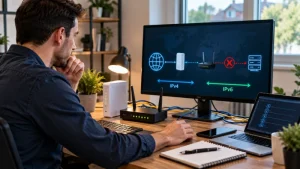
Firewall Or Router Restrictions
A firewall may intentionally block incoming connections.
Check:
- Router firewall settings
- Device firewall settings
- Service configuration
- Required ports
- Access-control rules
- ISP restrictions
Avoid disabling a firewall simply to make a connection work. Identify the precise rule or service causing the problem instead.
IPv4 And IPv6 Issues
Modern networks may use both IPv4 and IPv6.
An A record normally points towards an IPv4 address, while an AAAA record points towards an IPv6 address.
Problems can occur when:
- Only IPv4 is configured
- IPv6 is available but incorrectly configured
- A hostname contains an outdated AAAA record
- A client prefers IPv6 when the service only works over IPv4
Checking both record types can help identify these problems.
How To Secure Remote Access Using Dynamic DNS?
Security should be treated as a core part of remote-access configuration.
The UK’s National Cyber Security Centre recommends limiting network exposure and using controlled, secure approaches to remote connectivity rather than creating unnecessary access routes.
Important precautions include:
- Use A VPN Where Appropriate – A properly configured VPN can create an encrypted path into the network
- Enable Multi-Factor Authentication – MFA adds another barrier when credentials are compromised
- Use Unique Passwords – Do not reuse router, administrator or remote-access passwords
- Update Router Firmware – Security vulnerabilities in outdated networking equipment can expose the network
- Patch Remote Services – Keep servers and applications updated
- Disable Unused Services – Remove unnecessary internet-facing services
- Restrict Administrative Access – Only approved users should have administrator permissions
- Monitor Login Activity – Review failed logins and unusual access attempts
- Protect Router Administration – Avoid exposing router management interfaces directly to the internet
- Back Up Important Data – Maintain tested backups of business-critical information
Remote Desktop Protocol and similar administrative services should not simply be exposed publicly without appropriate protection.
Is Mysk2.dyndns.org Safe To Access?
A hostname alone cannot establish whether the service behind it is safe.
dyndns.org describes part of the hostname structure. It does not automatically verify the organisation controlling a particular subdomain or the content being served from it.
Before entering passwords, payment information or personal data into an unfamiliar destination, users should consider several checks.
- Confirm the Address – Make sure the hostname is exactly the one you intended to visit
- Check HTTPS – An encrypted connection protects data in transit, although HTTPS alone does not prove that an operator is trustworthy
- Review Certificate Warnings – Do not ignore unexpected browser certificate errors
- Avoid Unexpected Downloads – Be cautious if a page immediately asks you to download software
- Verify Login Requests – Unexpected credentials prompts should be treated carefully
- Keep the Browser Updated – Modern browser security protections depend on current software
- Do Not Override Security Warnings Without Understanding Them – Browser warnings can indicate certificate or connection problems
Third-party pages currently associate mysk2.dyndns.org with an online platform, while public DNS tools show the hostname has been configured with an A record.
Neither fact independently establishes the identity, ownership or safety of the operator behind the hostname.
Users should therefore avoid assuming that a DDNS hostname is safe simply because it resolves successfully.
Common Mysk2 Dyndns Org 3 Problems And Fixes
| Problem | Possible Cause | What To Check |
| Hostname Does Not Resolve | DNS Record Problem | DDNS Configuration |
| Wrong IP Appears | DDNS Update Failure | Current Public IP |
| Hostname Resolves But Does Not Connect | Firewall Or NAT | Network Configuration |
| Works On Local Wi-Fi Only | NAT Or CGNAT | Public Internet Access |
| Connection Stops After IP Change | DDNS Client Failure | Router Or Updater |
| Connection Is Intermittent | ISP Or Network Issue | Router Logs |
| IPv4 Works But IPv6 Fails | Incorrect AAAA Record | IPv6 Configuration |
| Browser Shows Certificate Warning | HTTPS Configuration | Certificate And Hostname |
It is important to identify which layer has failed before changing settings.
Changing firewall rules when the actual problem is DNS can create unnecessary security exposure without fixing the connection.
How To Troubleshoot A Dynamic DNS Connection Step By Step?
1. Check The Current Public IP Address
Confirm which public address the internet connection is currently using.
2. Check DNS Resolution
Run:
nslookup hostname.example
or:
dig hostname.example
Confirm whether the expected IP address appears.
3. Compare The Addresses
If the hostname points towards an older IP address, the DDNS updater may have stopped working.
4. Check For CGNAT
Compare the router’s internet-facing address with the public address detected externally.
If they differ significantly, CGNAT or another NAT layer may be present.
5. Check The Remote Service
Make sure the actual server or application is running.
A perfect DNS configuration cannot make an offline service accessible.
6. Check Firewall Rules
Confirm that legitimate traffic is permitted without disabling security controls unnecessarily.
7. Check The Router Configuration
If the chosen access method genuinely requires forwarding, confirm that traffic is being directed towards the correct internal device.
8. Test From Another Network
Do not rely entirely on testing from inside the same network.
An authorised test through a mobile data connection or another external connection can establish whether the service is genuinely reachable from outside.
9. Review Logs
Router, firewall and application logs can reveal whether connection attempts are:
- Arriving And Being Rejected
- Never Reaching The Network
- Reaching The Wrong Device
- Failing During Authentication
Logs are often more useful than repeatedly changing network settings.
Mysk2 Dyndns Org 3 Key Points To Remember
- dyndns.org Appears To Be A Hostname – It should not automatically be described as an independent DDNS provider
- Dynamic DNS Tracks Changing IP Addresses – It keeps a hostname associated with the latest address
- DNS Resolution Does Not Confirm Service Availability – The destination application may still be unavailable
- DDNS Does Not Provide Security By Itself – Encryption and access controls must be configured separately
- Port Forwarding Is Not Always Required – The correct method depends on how remote access is designed
- CGNAT Can Prevent Incoming Connections – A DDNS hostname may work correctly while direct remote access remains impossible
- Security Should Come First – Avoid exposing unnecessary administrative services to the public internet
- A Hostname Does Not Prove Trustworthiness – Verify unfamiliar destinations before entering sensitive information
Conclusion
Mysk2 Dyndns Org 3 is best understood by separating mysk2.dyndns.org from the Dynamic DNS technology supporting addresses of this type.
Dynamic DNS provides a practical way to keep a hostname connected to an internet service even when its public IP address changes.
It can support remote servers, NAS systems, business networks and other authorised services, but DDNS alone does not create a secure remote connection.
Users should verify how a hostname resolves, distinguish DNS problems from network problems and consider CGNAT, firewall configuration, IPv4, IPv6 and the availability of the destination service when troubleshooting.
Most importantly, the existence of a Dynamic DNS hostname should never be treated as proof that the service operating behind it is trustworthy.
Remote-access systems should use appropriate authentication, encryption, updates and network security controls.
FAQs About Mysk2 Dyndns Org 3
What Is Mysk2 Dyndns Org 3?
Mysk2 Dyndns Org 3 generally refers to mysk2.dyndns.org, which appears to be a hostname under a Dynamic DNS domain rather than evidence of a standalone DDNS provider called Mysk2.
Is Mysk2.dyndns.org A Dynamic DNS Provider?
The hostname itself should not be treated as a Dynamic DNS provider. The dyndns.org portion relates to Dynamic DNS infrastructure, while mysk2 represents a hostname or subdomain created under it.
Is Mysk2.dyndns.org Safe?
The hostname format alone cannot determine whether a destination is safe. Users should verify the address, connection security, browser warnings and the identity of the service before providing credentials or sensitive information.
Why Is Mysk2.dyndns.org Not Working?
Possible causes include an outdated DNS record, server downtime, firewall restrictions, incorrect NAT configuration, CGNAT, IPv4 or IPv6 issues, or changes to the service operating behind the hostname.
Do I Need Port Forwarding For Dynamic DNS?
Not necessarily. DDNS and port forwarding perform different functions. Some traditional remote-access systems require forwarding, while VPNs, secure gateways and other approaches may not require direct inbound port exposure.
Can Dynamic DNS Work Behind CGNAT?
The DNS record itself can still update behind CGNAT, but direct inbound connections may fail because the customer does not control a publicly reachable IPv4 address.
What Is The Difference Between DDNS And A Static IP?
A static IP normally remains unchanged, while DDNS continuously updates a hostname when a dynamic IP changes. Both can support remote-access systems when they are configured correctly.
Can I Use Dynamic DNS For Business Remote Access?
Yes, Dynamic DNS can form part of a business remote-access setup. However, organisations should combine it with appropriate authentication, encryption, firewall controls, updates and a securely designed remote-access method.